Some towns happen by accident. Homer happened because people kept arriving at Kachemak Bay, looking around, and deciding to stay.
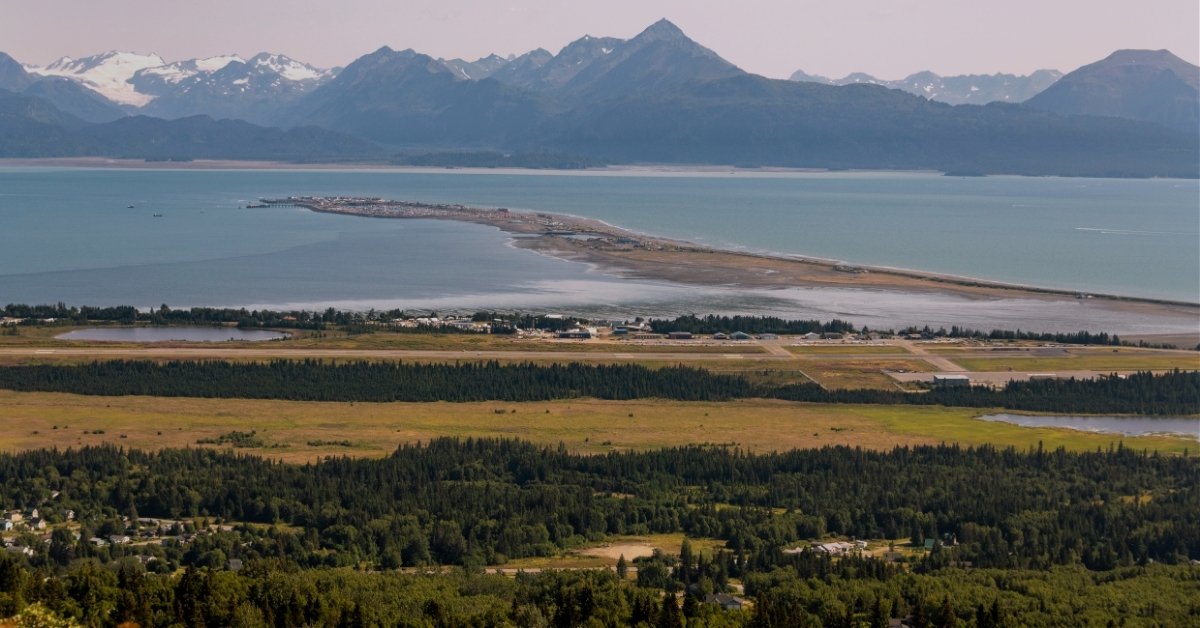
It is easy to see why. The bay runs 39 miles inland, framed by the Kenai Mountains and the glaciers behind them, with a 28 foot tidal range that turns the shoreline into one of the most productive stretches of water in Alaska. Out into the middle of it reaches the Homer Spit, 4.5 miles of gravel and grit, the second longest spit in the country. Stand at the end of it on a clear evening and you understand the whole story in about ten seconds.
Deep roots
The bay has supported people for thousands of years. Sugpiaq and Alutiiq communities built their lives around its salmon, shellfish, seabirds, and marine mammals, and by the time European charts started appearing, Dena’ina Athabascans held the country around the head of the bay. The Dena’ina name for the Spit, Uzintun, describes something reaching out into the distance, which is exactly what it does.
That heritage is living, not archived. It shows up in the collections and programming at the Pratt Museum, which has been telling the region’s story since 1968, and in the families who have fished and gathered here for generations.
Coal, gold, and a name that stuck
Russian mariners charted the point as Coal Cape, because the seams in the bluffs are impossible to miss. By 1889 outfits were mining them, and in 1892 a small settlement called Coal Bay took shape at the base of the Spit.
Then came Homer Pennock. He arrived in 1896 with a crew of about 50 and a great deal of enthusiasm about gold. The gold never amounted to much, but the town needed a name for its post office, and his was the one on hand. Coal turned out to be the real business. In 1899 the Cook Inlet Coal Fields Company built a dock, 28 buildings on the Spit, and a seven mile railroad running down from the mines at Bluff Point, Eastland Creek, and Fritz Creek.
Homer has been named after an optimist ever since, which suits the place.
Homesteaders and the road
A steady wave of homesteaders began settling the benches above the bay around 1915. They cleared ground, ran cattle, put in gardens, fished, and built a community that could take care of itself. A general store opened in 1918. Much of that homesteading spirit is still visible, and you can walk right into it at the Kilcher Homestead and at the Pratt.
The Sterling Highway reached Homer around 1950 and connected the town to the rest of Alaska for the first time. The effect was immediate. Population climbed from 307 in 1950 to nearly 1,250 by 1960, a hospital opened in 1955, and Homer’s halibut and salmon fleets could finally get fresh fish to market fast. The foundation of today’s working harbor was laid in those years.
The Cosmic Hamlet by the Sea
In 1957 a group known locally as the Barefooters settled 480 acres at the head of the bay. Their community eventually dissolved, but several members stayed on and became beloved townspeople. The best known, Brother Asaiah Bates, served on the Homer City Council, joined the Chamber of Commerce, and spent decades supporting local kids and scholarships. His nickname for the town, the Cosmic Hamlet by the Sea, is still the most accurate two word description of Homer’s warmth and openness anyone has produced.
Rebuilt and chosen
Homer’s incorporation was certified on March 31, 1964, four days after the Good Friday earthquake. The Spit subsided several feet and the harbor breakwater was damaged. The town got to work, raised the road, rebuilt the harbor, and came out of it with the infrastructure that still serves the fleet today. Homer’s first act as a city was to rebuild itself, and it did.
What came next says even more. In 1970 the Alaska Legislature created Kachemak Bay State Park, the first state park in Alaska, protecting the wild shoreline across the water. In 1976, when oil leases were sold in the bay, residents spoke up and the state bought them back. In 1999 the Kachemak Bay Research Reserve was established, and in 2003 the Alaska Islands and Ocean Visitor Center opened as headquarters for both the Reserve and the Alaska Maritime National Wildlife Refuge.
Homer chose this bay on purpose, repeatedly, and protected it.
Come see it
Today Homer is a working fishing port, a serious arts town, a science hub, and a genuinely welcoming place at the end of the road. Fish for halibut, kayak across to the state park, catch the Shorebird Festival in May, browse the galleries on Pioneer Avenue, walk the Spit at low tide.
People have been coming to this bay for thousands of years and deciding to stay. You will understand why.