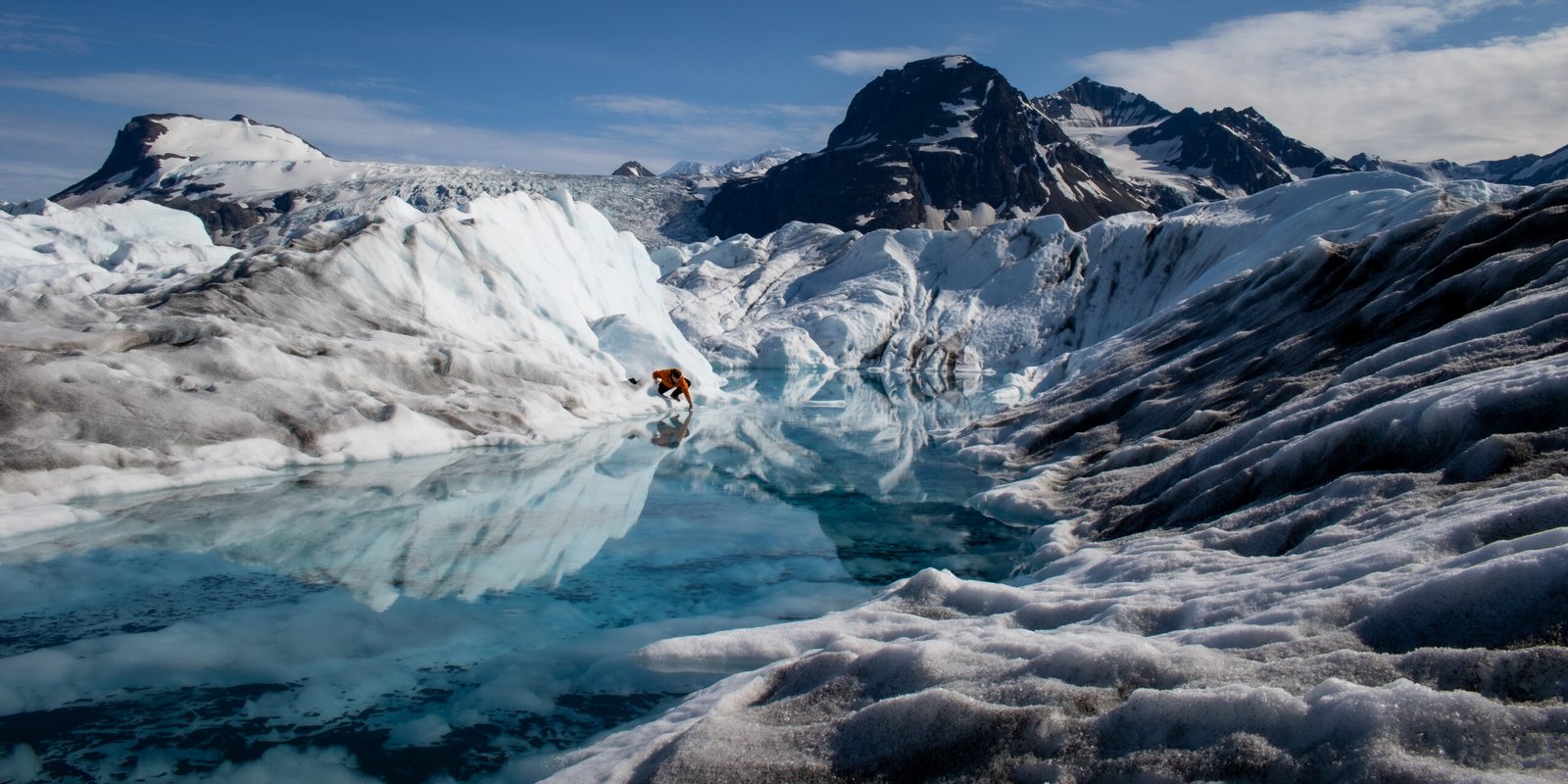
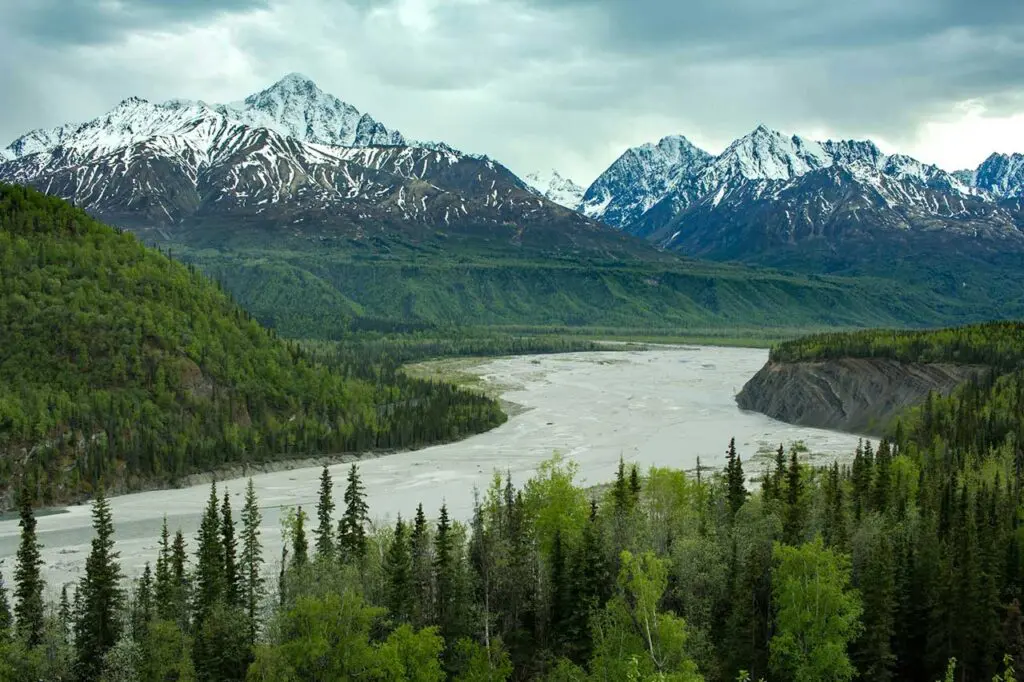
Seventy five miles east of Anchorage, close enough that you could drive most of the way there before lunch, stands one of the most impressive mountains in North America. Most Alaskans have never laid eyes on it.
Mount Marcus Baker rises 13,176 feet at the head of the Knik and Matanuska glaciers, the high point of the entire Chugach Range. What makes it extraordinary is not the summit elevation, which is modest by Alaska standards, but how far it rises from where it starts. Its topographic prominence is 10,726 feet, which puts it eighth among all peaks in the United States and 67th in the world. The mountain climbs out of tidewater country and keeps going. Its summit sits just 12 miles north of the calving face of Harvard Glacier in Prince William Sound.
There is no road to it. No trail. No viewpoint with a parking lot. That is precisely what makes it worth writing about.
Older names, and a mapmaker
Long before it appeared on any American chart, the peak had names. The Ahtna call it Ts’itonhna Dghilaaye’. In Dena’ina it is Ch’atanhtnu Dghelaya. Prince William Sound and the mountains above it are the homeland of Alutiiq, Eyak, and Chugach people, who have lived with and cared for this country for thousands of years.
The current name arrived in 1924, when Alfred Brooks of the U.S. Geological Survey named the peak for Marcus Baker, a cartographer who spent his career mapping Alaska for the Coast and Geodetic Survey and the USGS. It is a fitting tribute. Baker helped make the country legible, and the mountain named for him remains one of the least trafficked places in it.
The first ascent came in 1938, when a party including the great mountain photographer Bradford Washburn reached the top. Nearly ninety years later, summits are still counted in ones and twos.
A landscape built for protection
Marcus Baker anchors the northern end of a stretch of country with an unusually strong conservation framework, most of it built deliberately over the past century.
The Chugach National Forest, established in 1907, covers 5.4 million acres of mountains, glaciers, rivers, and coastline, making it the second largest national forest in the United States. It reaches from the Kenai Peninsula across Prince William Sound to the Copper River Delta, taking in a huge share of the glacial systems that drain the Chugach Range.
In 1980, Congress used the Alaska National Interest Lands Conservation Act to designate roughly two million acres along western Prince William Sound as the Nellie Juan-College Fiord Wilderness Study Area. It is the largest wilderness study area in the country. This is the ice that Marcus Baker feeds, holding the densest concentration of tidewater glaciers anywhere in Alaska, with rivers of ice running a dozen miles from summit snowfields to walls of ice standing hundreds of feet above salt water. The Forest Service manages it to preserve that wild character, and the 2020 Chugach Land Management Plan recommends more than 1.38 million acres of it for permanent wilderness designation.
At the western end of the range, Chugach State Park protects close to half a million acres right up against Anchorage, created in 1970 and now one of the most heavily used state parks in the country. Very few cities anywhere have that kind of mountain wilderness at the edge of the neighborhoods.
Together these designations do something rare. They keep an entire mountain range, from tidewater to 13,000 feet, largely intact.
Why it matters
This is not scenery for its own sake. The Chugach icefields feed the rivers that carry Southcentral Alaska’s salmon runs. The high country holds Dall sheep, mountain goats, wolverines, and brown bears with room enough to move. The glaciers themselves are among the most closely watched in the world, giving scientists a long running record of how the region’s ice and water are changing.
Forest planning here now brings Alaska Native Tribes, Native corporations, the State of Alaska, boroughs, and the public to the same table. That collaboration is the reason this landscape still works as one connected system rather than a patchwork.
Go look at it
You will probably not climb Mount Marcus Baker, and that is fine. There are better ways to meet it.
Take a flightseeing trip out of Anchorage or Palmer and watch the Knik and Matanuska glaciers unspool beneath you toward the peak. Hike the ridges in Chugach State Park, where the same range is right there and free to walk into. Take a boat into College Fjord and see where all that ice ends up.
Then support the work. Visit the Forest Service and state park facilities, weigh in when management plans open for comment, join a friends group, and pack out what you bring in.
Alaska still has a 13,000 foot mountain with no road to it, an hour and change from its largest city. Keeping it that way is a choice, and it is one worth making again in every generation.