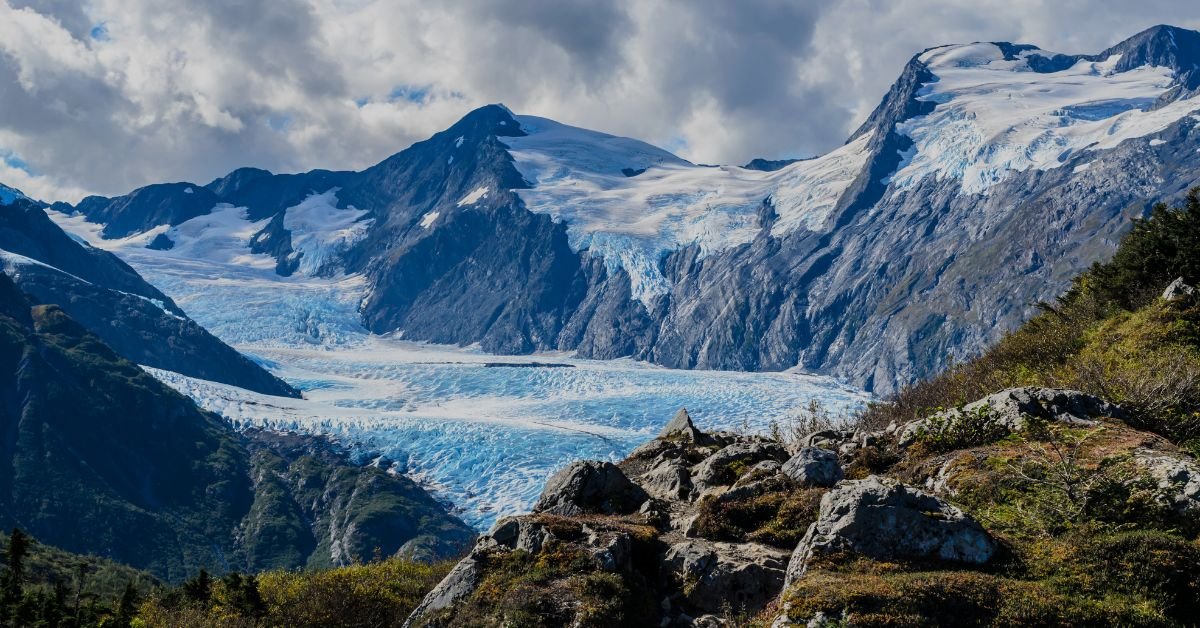
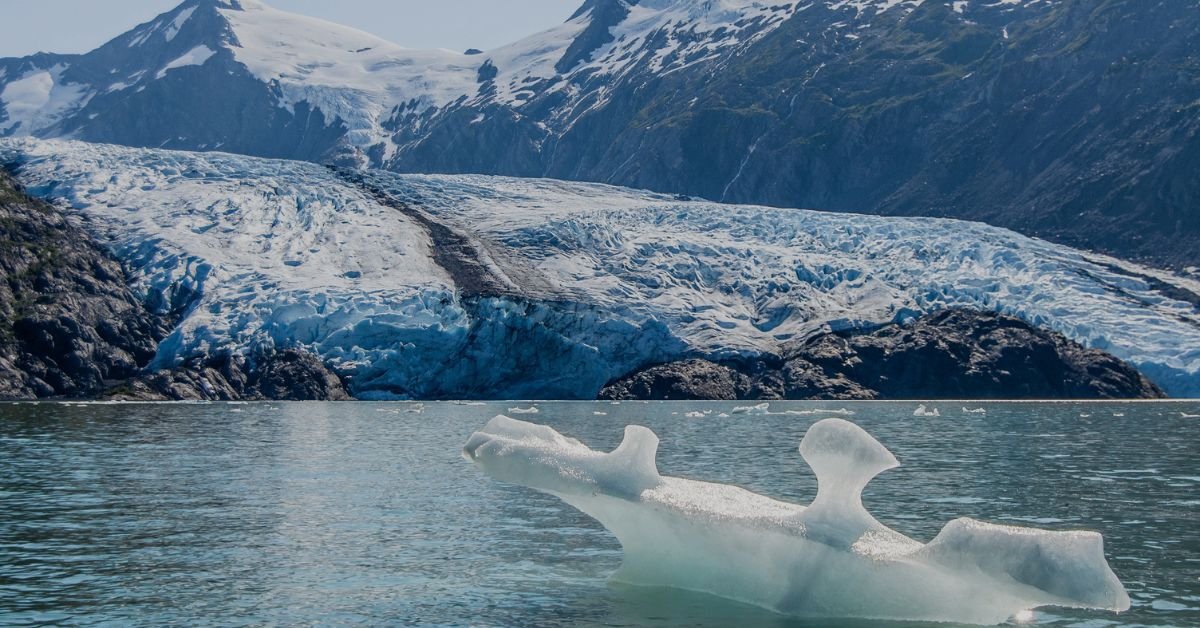
Fifty miles south of Anchorage, at the end of a five mile road off the Seward Highway, sits a visitor center built to frame a glacier that is no longer there. The Begich, Boggs Visitor Center opened in 1986 on the shore of Portage Lake with its windows aimed straight at Portage Glacier. Within about a decade the ice had backed around a bend and out of sight. The building is still very much worth visiting. It has just quietly become an exhibit about its own subject leaving.
A road before there were roads
The glacier is named for what people did with it. For thousands of years the low gap now called Portage Pass was the shortcut between Prince William Sound and Turnagain Arm, a crossing of roughly 14 miles that spared travelers a long and dangerous trip around the Kenai Peninsula. Chugach and Dena’ina people used it for travel, trade, and conflict. Russian fur traders used it. Then in the 1890s the Alaska gold rush sent steamships into Passage Canal to unload prospectors at the foot of the pass.
Those prospectors did not walk beside the glacier. They walked on it. In that era ice filled the entire basin where Portage Lake now sits, hundreds of feet deep, and its eastern face was a wall. Men hauled gear up with ropes and pulleys, then followed a beaten path across the ice down Portage Valley toward the strikes at Hope and Sunrise. The name Portage Glacier was first recorded in 1898. It described a working route, not a scenic attraction.
A century of retreat
The withdrawal had already begun. Warming at the close of the Little Ice Age in the mid 1800s set it in motion, and in 1914 the first corner of open water appeared at the western end of the basin. Portage Lake, about five miles long and roughly 600 feet deep in places, is barely a century old.
What followed was startlingly fast. Once the terminus backed off solid ground and into deep water, the glacier stopped simply melting and started calving, shedding icebergs into a basin it had carved for itself. Between 1939 and 1950 the ice pulled back 140 to 160 meters per year. USGS records document a total retreat of nearly five kilometers over the century. By 1999 the terminus had reached the shallower eastern end of the lake, where the retreat slowed dramatically. It has stayed relatively stable since.
That last detail complicates the tidy version of the story. Climate started the retreat, but the runaway phase was largely a matter of water depth. Deep water lifts and destabilizes a glacier’s face, so calving accelerates. Shallow water does not. Portage is still thinning, like nearly every glacier in the Chugach, but it is no longer in freefall.
Protecting what remains
Portage sits within the Chugach National Forest, which has shaped how the whole valley is managed. The visitor center carries the names of Nick Begich of Alaska and Hale Boggs of Louisiana, two congressmen whose plane vanished near this country in October 1972 and was never found.
The most consequential recent conservation win happened quietly in 2021. The trailhead and parking area for the Portage Pass Trail sat on a private inholding, meaning public access to the historic route was never actually guaranteed. The Conservation Fund acquired roughly 250 acres in Whittier using Land and Water Conservation Fund money and transferred it to the Forest Service. The trail, part of the Iditarod National Historic Trail system, is now permanently open to the public. Full and permanent LWCF funding, secured through the Great American Outdoors Act in 2020, is what made the deal possible.
Conservation here also means keeping visitors safe from the thing they came to admire. In February 2025 an enormous section of the glacier face collapsed onto the frozen lake while skaters were out on the ice nearby. Nobody was hurt, but it was close, and the Forest Service and local safety educators have used it to repeat a simple point: glaciers calve in winter too, so stay well back from the face in every season.