
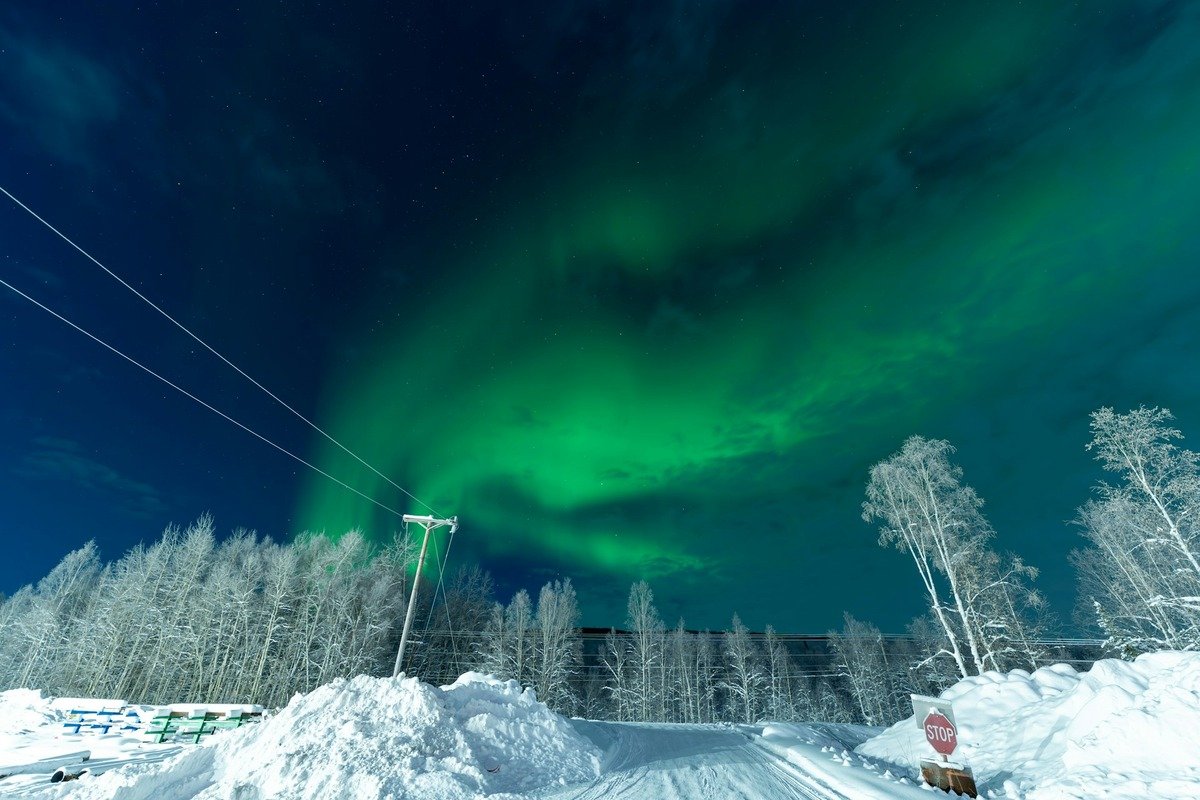
Nobody can tell you exactly when the aurora will appear. You need darkness, clear skies, and enough activity overhead, and even then, there are no guarantees. Northern latitude and distance from city lights simply improve your chances.
For the best mix of access and viewing potential, Fairbanks is the practical base. Travel between September and March, stay for several nights, and start checking the sky around 10 p.m. Look again later if nothing happens. On an Alaska Northern Lights trip, cloud cover matters just as much as the activity forecast.
What Actually Makes the Alaska Northern Lights Appear?
Charged particles from the sun collide with gases high above Earth, releasing light. Green is the color people see most often, though stronger displays can bring red, blue, or purple.
Earth’s magnetic field pulls those particles toward the poles, which is why Interior and Arctic Alaska usually have the best odds. Strong activity can carry the aurora farther south.
The lights occur year-round. What changes is whether the sky gets dark enough to see them.
When Does Northern Lights Season Really Begin and End?
Viewing season runs from late August through April, though the window changes with latitude. The aurora does not stop in spring. The nights become too bright to see it.
Late August Through October
Darkness returns first in northern Alaska. This period gives you a chance to see the Alaska Northern lights without the coldest winter temperatures, though the weather can turn quickly, and Denali may see snow in September.
November Through February
These months bring the longest nights and the harshest conditions. In the Brooks Range, temperatures can drop below -50°F, while winter travel may involve river ice and avalanche terrain.
March Through Early April
Much of Alaska still gets enough darkness in March and early April, while longer days make driving and daytime plans easier. For many first-time visitors, March offers the most practical balance.
The main Northern Lights season Alaska travelers should plan around runs from September through March. Treat late August and April as less dependable edges. Plan the rest of your days around it, so the trip still works if the sky stays quiet.
What Time of Night Should You Be Outside?
There is no fixed hour when the aurora appears. Around Denali, the sky is usually dark enough from about two hours after sunset until two hours before sunrise. The most useful viewing window is often between 10 p.m. and 2 a.m.
Still, treat that as a rough guide. The lights may show earlier, build after 2 a.m., disappear, then return.
Check sunset and sunrise times for your travel dates, especially in August and April, when nighttime may not mean full darkness. Set an alarm, check more than once, and have somewhere warm to wait between looks.
Where in Alaska Should You Base Yourself?
The darkest skies are not always the easiest to reach. For most visitors, the better choice is somewhere that offers good viewing without difficult winter travel.
Fairbanks and Interior Alaska
Fairbanks is the strongest option. You get northern latitude, accommodation, roads, and public land, with room to move when clouds roll in. That makes Fairbanks aurora viewing easier than a remote winter trip.
BLM describes the White Mountains as a leading aurora area. The region has winter trails and public-use cabins, although some require skis, a dog team, or a snowmachine.
For visitors, the best place to see the aurora in Alaska without complicated logistics is Fairbanks. Roads and a warm bed matter, too.
Denali and the Parks Highway
Denali has little light pollution and enough darkness from mid-August through mid-April. Winter access is limited. Much of the park road closes, and summer buses stop.
Anchorage and Chugach State Park
Anchorage is a practical option if it is already part of your trip. Chugach access points, including Eklutna Lake, offer darker skies beyond the city’s brightest streets. Sightings are less consistent than around Fairbanks, especially during weaker aurora activity.
Wrangell–St. Elias and the Copper River
This region offers dark country along the Richardson and Glenn highways from late August through April. Services are spread out.
Homer and the Kenai Peninsula
The Alaska Northern Lights are visible from Southcentral Alaska when activity is strong. Because the Kenai Peninsula sits farther from the auroral oval, Homer usually needs a brighter display. Plan the trip for Homer, with aurora as a welcome extra.
The Brooks Range and Arctic Alaska
Gates of the Arctic has exceptional darkness but no roads or maintained trails. Winter travel brings severe cold, avalanche terrain, and river ice that can kill you. This is expedition country, not a casual stop.
What Can Wreck a Good Forecast?
Cloud cover can hide even a strong aurora, so check the weather as carefully as the activity forecast. Town lights and a bright moon can wash out weaker displays, although a strong aurora will still show.
Start with the NOAA Aurora Dashboard, then check your nearest NWS Alaska forecast for cloud cover, wind chill, snowfall, visibility, and road warnings. Confirm that the viewing area is open and safe to reach before leaving.
Watching the Alaska Northern lights often means standing still beside a vehicle for long periods. Bring more layers than you would for a short walk. Drive slowly, as moose often use plowed roads and can be difficult to see in darkness or blowing snow. Check avalanche conditions before leaving maintained roads, and avoid unfamiliar mountain terrain at night.
How Many Nights Do You Need, and What Will You Actually See?
Give yourself several nights for Alaska Northern Lights viewing. Cloud and aurora activity change separately, so a strong forecast can still be hidden, while a clear night may stay quiet. One evening leaves no room for either.
Expect the real display to look softer than it does in photos. Long exposures collect more light, making faint aurora appear brighter and more colorful. Weak activity may look like a pale gray or white band, while green is far more common than vivid red or purple.
Let your eyes adjust for about 30 minutes. Keep phone screens and headlamps low, then watch faint bands for movement or changing shape. When you are unsure whether you are seeing a cloud or an aurora, check briefly through your phone camera.
What Did You See?
The Alaska Northern Lights reward people who report back honestly. Post the date, the spot, the cloud conditions, what the forecast said, what you saw, and whether you would go back. That is the kind of note the rest of us can plan against. Get in touch with Launch Point and tell us how your nights went.